

The Buontalenti Grotto at Boboli Gardens — 2026 Guide
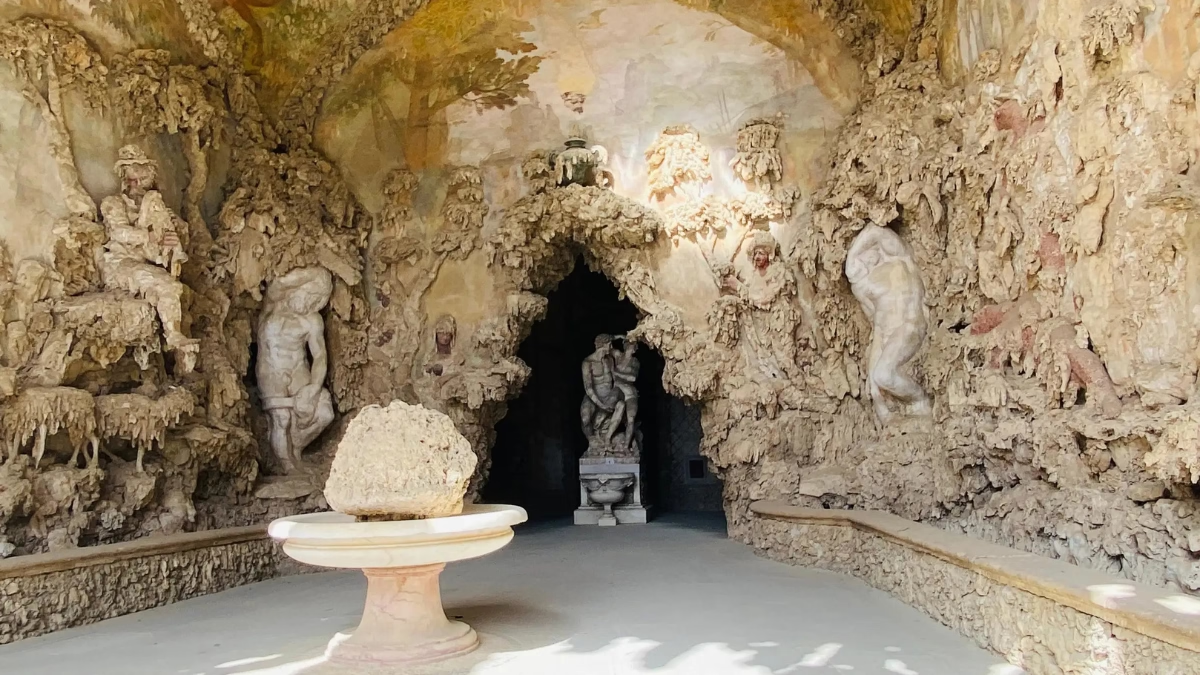
The Buontalenti Grotto is a Mannerist artificial cave built at Boboli Gardens between 1583 and 1593 by Bernardo Buontalenti for the Medici. It has three chambers decorated with stalactite-like sponge stone, frescoes and sculpture — the first chamber once held Michelangelo’s unfinished Prisoners (now casts). It stands near the garden entrance and is one of Boboli’s most famous features.
Of everything the Medici built at Boboli, nothing captures the strange imagination of the late Renaissance like the Buontalenti Grotto. It looks, at first, like a rocky natural cavern that has erupted through a classical facade — which is exactly the effect its designer wanted. Inside, sculpted figures seem to emerge from dripping stone, painted scenes cover the vaults, and water once trickled through the whole illusion.
This guide explains what the grotto is, who built it and when, what to look for in its three chambers, the story of Michelangelo’s Prisoners, the nearby Grotta di Madama, and how and when to see it during your visit in 2026.
The Buontalenti Grotto at a Glance
| Detail | The Buontalenti Grotto |
|---|---|
| Built | 1583–1593 |
| Designer | Bernardo Buontalenti |
| Style | Mannerist |
| Chambers | Three |
| Location | Near the main Boboli entrance, above the amphitheater |
| Once held | Michelangelo’s Prisoners (now plaster casts) |
What Is the Buontalenti Grotto?
It is an artificial grotto — a man-made cave — designed as a piece of theatrical garden architecture. Built for the Medici in the 1580s and 1590s, it plays deliberate games with nature and art: the rough, dripping-stone interior looks geological, but every surface is sculpted, frescoed or arranged for effect. This blurring of the natural and the artificial is the essence of the Mannerist style it belongs to.
The grotto was never meant to be a real cave. It is a showpiece of the Mannerist taste that dominated the Medici court in the late 16th century — a style that prized invention, surprise and the sense that art could out-do nature. Behind a classical facade of columns and niches, the interior opens into rough grottowork encrusted with sponge-like stone, giving the impression of a cavern in the middle of a formal garden.
For the Medici, a grotto like this was both a curiosity and a status symbol. It offered cool shade in summer, a setting for waterworks, and a stage for the kind of intellectual playfulness their court enjoyed. It sits close to the main entrance, just off the route up to the hillside amphitheatre, which makes it one of the first major features many visitors reach.
Who Built It and When
The grotto was designed by Bernardo Buontalenti, the Medici court’s leading architect, engineer and impresario of spectacle, and built between 1583 and 1593. Buontalenti was the same designer behind much of the era’s stagecraft in Florence, and the grotto shows that theatrical instinct at full stretch. An earlier structure on the site was reworked into the elaborate three-chambered space that survives today.
Buontalenti’s grotto belongs to the same great wave of Medici garden-making that shaped the rest of Boboli. To understand how it fits the wider story of the garden’s designers — Tribolo, Ammannati, Vasari and Buontalenti himself — see our overview of Boboli Gardens history.
The Three Chambers
The Buontalenti Grotto is arranged as three linked chambers. The first is the most dramatic, with sponge-stone walls, frescoes of shepherds and animals, and the niches that once held Michelangelo’s Prisoners. The second contains a sculptural group by Vincenzo de’ Rossi, and the third, the innermost, holds Giambologna’s fountain figure of Venus (Bathing Venus) rising from the basin.
The first chamber is the theatrical heart of the grotto. Its walls are covered in irregular sponge stone that mimics dripping stalactites, and the vault carries frescoes that dissolve the boundary between the painted and the sculpted. Set into the corners are the figures that made the chamber famous — originally Michelangelo’s unfinished Prisoners, whose rough, half-emerged forms suited the cave-like setting perfectly.
Moving deeper, the second chamber holds a sculptural group, and the innermost third chamber is the quietest and most intimate, centered on Giambologna’s fountain statue of Venus emerging from her bath. The progression from wild grottowork to a refined sculptural climax is part of the design’s logic — a journey from raw nature to polished art, exactly the contrast the Mannerist mind delighted in.
Michelangelo’s Prisoners
The first chamber of the grotto once displayed Michelangelo’s four unfinished Prisoners (or Slaves), sculptures of figures struggling to free themselves from the marble. Their rough, incomplete surfaces fit the cave setting so well that they seemed to grow from the walls. The originals were moved to the Accademia Gallery in 1908 for protection, and faithful plaster casts now stand in their place.
The Prisoners are among the most powerful sculptures of the Renaissance — figures that appear to fight their way out of the stone, deliberately left unfinished by Michelangelo. For centuries they stood in Buontalenti’s first chamber, where their raw energy amplified the grotto’s illusion of nature caught mid-formation.
To protect the originals, they were transferred to the Galleria dell’Accademia — home of Michelangelo’s David — in the early 20th century, and casts were installed at Boboli. Seeing the casts in situ is still worthwhile: it shows exactly why the pairing of the unfinished figures with the grotto was such an inspired piece of display. If you want the originals, plan a separate visit to the Accademia in central Florence.
The Grotta di Madama Nearby
Just beside the great grotto is a smaller, earlier one: the Grotta di Madama, or Grotto of Madama. It predates Buontalenti’s work and is a more modest, intimate space, but it set the precedent for the grand grotto that followed. Together the two show how the idea of the garden grotto developed at Boboli over the decades.
The Grotta di Madama is easy to overlook because it sits so close to its famous neighbor, but it rewards a moment’s attention for its finely worked interior. Both grottoes belong to the cluster of features near the main entrance, alongside the fountains and the amphitheater, so you can see them all early in a visit without much extra walking.
How and When to See It
The grotto stands near the main Pitti Palace entrance to the garden, a short climb from the ticket gate, so it is one of the first highlights you reach. Access to the interior can be restricted, and viewing is sometimes limited to set times, through a grille, or to the outer chamber only, in order to protect the fragile decoration — so check on the day and be ready to admire it from the entrance if the inner chambers are closed.
Morning is the best time to see it, before tour groups arrive and while the light on the facade is soft. A digital audio guide helps here, because the grotto carries little on-site signage; a reserved entry ticket with the audio app covers the whole garden and adds commentary as you go. For the calmest conditions overall, our guide to the best time to visit is worth a look before you plan the day.
Frequently Asked Questions
What is the Buontalenti Grotto?
It is an artificial Mannerist grotto — a man-made cave — built at Boboli Gardens for the Medici between 1583 and 1593. Designed by Bernardo Buontalenti, it has three chambers decorated with sponge-like stone, frescoes and sculpture, arranged to blur the line between nature and art. It is one of the most famous features of the entire garden and stands near the main entrance behind Pitti Palace.
Who built the Buontalenti Grotto and when?
The architect Bernardo Buontalenti built it between 1583 and 1593, reworking an earlier structure on the site. Buontalenti was the Medici court’s master of spectacle and stagecraft, and the grotto reflects that theatrical imagination. He was one of the four great designers — with Tribolo, Ammannati and Vasari — who shaped Boboli Gardens across the second half of the 16th century.
Are Michelangelo’s Prisoners still in the grotto?
No. The four unfinished Prisoners (also called the Slaves) that once stood in the first chamber were moved to the Galleria dell’Accademia in Florence in 1908 to protect them. Faithful plaster casts now occupy their original niches in the grotto. To see the real sculptures you need to visit the Accademia, the same gallery that houses Michelangelo’s David.
Can you go inside the Buontalenti Grotto?
Sometimes, but access is often restricted to protect the delicate interior. Viewing may be limited to certain times of day, to guided or timed access, or to the outer chamber and the facade. Conditions change, so check on arrival. Even from the entrance the grotto is striking, and the frescoed first chamber with its sponge-stone walls is visible enough to appreciate the effect.
What are the three chambers of the grotto?
The first chamber is the most theatrical, with sponge-stone walls, frescoes and the niches that once held Michelangelo’s Prisoners. The second holds a sculptural group, and the innermost third chamber centers on Giambologna’s fountain figure of Venus rising from a basin. The sequence moves from wild, cave-like grottowork toward refined sculpture — a deliberate contrast typical of the Mannerist style.
Where is the grotto in Boboli Gardens?
It sits near the main Pitti Palace entrance, a short walk up from the ticket gate and close to the start of the route toward the amphitheater. Because it is so near the entrance, it is usually one of the first major features visitors reach. The smaller Grotta di Madama stands right beside it, so you can see both together.
Is the grotto included in the Boboli ticket?
Yes. The Buontalenti Grotto is part of Boboli Gardens, so a standard Boboli entry ticket covers it, subject to whatever access limits are in place on the day. There is no separate charge for the grotto. The garden ticket also covers the Bardini Gardens and the Porcelain Museum, though not the indoor galleries of Pitti Palace.
What is the Grotta di Madama?
The Grotta di Madama is a smaller, older grotto next to the Buontalenti Grotto. It predates Buontalenti’s grand cave and is more intimate, with its own finely worked interior. It represents an earlier stage in the garden’s fashion for grottoes and is easy to combine with a look at its famous neighbor, since the two stand side by side near the entrance.
How long should I spend at the grotto?
Ten to twenty minutes is usually enough to take in the facade, the frescoes and the chambers you can view, longer if you have the audio guide running. Since the grotto sits near the entrance, it fits naturally at the start of the two-to-three-hour circuit that most visitors walk — see our guide on how long to spend for pacing the whole garden.
