

Boboli Gardens Sculptures & Statues: Complete Guide
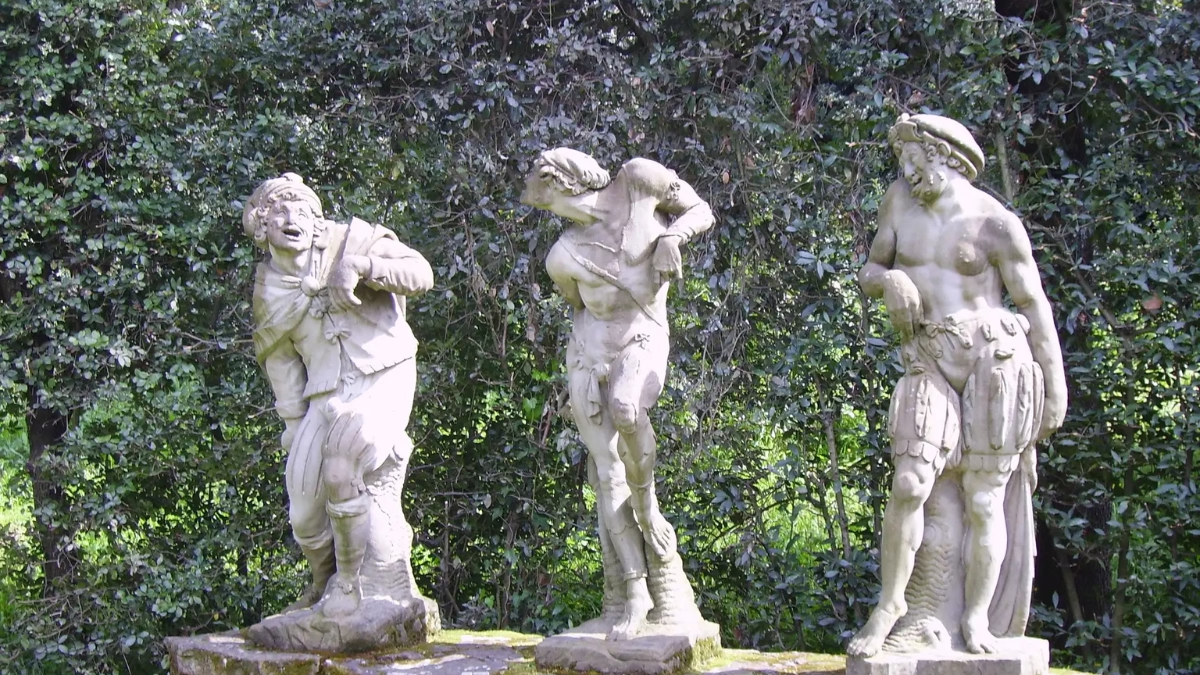
Boboli Gardens is essentially an open-air museum of sculpture, mixing antique Roman statues restored by the Medici with 16th- and 17th-century Mannerist works. Highlights include the Fat Bacchus (the court dwarf Morgante riding a turtle), the ranks of statues lining the Viottolone avenue, and Giambologna’s Oceanus on the Isolotto. Many outdoor figures are weather-proof copies, with the marble originals now in Florence museums.
Walk into Boboli and you walk into a collection. Over four centuries the Medici and their successors placed hundreds of statues along the garden’s avenues, terraces and pools, turning the hillside behind Pitti Palace into a gallery without a roof. The range is unusual: genuine ancient Roman marbles sit a few paces from playful court sculptures and grand mythological groups, all arranged to be read as you move.
This guide sorts the collection into what you can actually find on a visit — the antique statues, the Mannerist set pieces, the famous Fat Bacchus, the avenue of figures on the Viottolone — and explains the copies-versus-originals question that trips up so many visitors.
An Open-Air Museum of Sculpture
Boboli functions as an open-air museum because the Medici used the garden to display their sculpture collection outdoors, combining restored antique Roman statues with newly commissioned Renaissance and Baroque works. There is no single gallery building; instead the statues are sited along paths, on terraces and in pools across roughly 45 hectares, so the whole garden is the exhibition.
The idea took shape from 1549, when the garden was laid out for the Medici. Unlike a museum where works hang on walls, Boboli’s sculptures were placed to shape how you move — flanking an avenue to draw you downhill, closing a vista at the end of a path, or crowning a fountain. That siting is deliberate and still legible today, which is why the collection reads differently from the same statues gathered indoors.
The mix is the pleasure. In one afternoon you pass from cracked Roman marbles nearly two thousand years old to muscular Mannerist figures full of twist and movement, to lighthearted garden ornaments. Bring a little context and the garden becomes a walk through changing tastes in Florentine sculpture; our garden history guide sets out how the collection grew.
Antique Roman Statues
Some of the oldest works in Boboli are genuine Roman antiquities, collected and restored by the Medici and set into the garden as prized possessions. The clearest place to meet them is the amphitheatre, where niches around the grassy bowl hold ancient statues, and where an actual Roman granite basin and an Egyptian obelisk anchor the space. These pieces gave the garden instant gravitas, linking the Medici to the prestige of antiquity.
Restoration in this period was creative. Roman fragments were often completed with new heads, arms or attributes to make whole figures, so an “antique” statue in Boboli may blend genuine ancient marble with Renaissance additions. That layering is part of the story rather than a flaw, and it explains why some pieces look subtly mismatched up close.
Mannerist Masterworks and Garden Groups
Boboli is also a showcase of Florentine Mannerism, the elaborate, muscular style that followed the High Renaissance. The garden’s standout is Giambologna’s Oceanus group on the Isolotto, a colossal sea god over three river gods that closes the great pool at the foot of the Viottolone. Its restless energy and multiple viewpoints are Mannerism at full stretch, meant to be circled rather than seen head-on.
Water and sculpture often combine here. The Neptune Fountain’s bronze sea god, the mythological figures worked into the garden’s basins, and the statues framing the amphitheatre all belong to this ambitious 16th- and 17th-century program. If the fountains are what draw you, our fountains guide covers the sculpted figures at their centers in more detail.
The Fat Bacchus — Morgante the Dwarf
The Fat Bacchus is a small, famous statue near the Pitti Palace end of the garden showing Morgante, a court dwarf of Cosimo I de’ Medici, portrayed nude and rotund astride a turtle. It parodies the grand heroic nude, and its comedy and affection make it one of Boboli’s most photographed and best-loved works. It is often called simply “the fountain of Bacchus.”
Not everything in Boboli is heroic. Near the palace stands one of the garden’s most beloved oddities: a plump, naked figure riding a tortoise, known as the Fat Bacchus. The figure is a portrait of Morgante, a dwarf at the court of Cosimo I, and the statue affectionately turns him into a comic inversion of the idealized classical nude that surrounds him elsewhere in the garden.
The tortoise is the punchline. Where a hero might ride a rearing horse, Morgante perches on the slowest of mounts, a small joke about pomp that Medici visitors would have enjoyed. Sited near the Pitti Palace entrance, it is one of the first statues many visitors meet and a reliable favorite with children.
Statues Along the Viottolone
The single greatest concentration of sculpture is the Viottolone, the steep cypress avenue running down the garden’s secondary axis. Its double rows of cypresses are lined with statues — antique figures and later works alike — spaced so that they scroll past you as you descend toward the Isolotto. The effect is a processional gallery, each figure a waypoint on the long walk down.
Because the avenue is long, exposed and one of the quieter corners of the garden, it is also one of the best places to actually look at individual pieces without a crowd. Take the descent slowly, and the statues reward attention that the busier terraces near the palace rarely allow. Our dedicated Viottolone guide covers the walk itself and the best light for it.
Copies vs Originals — What You Actually See
Many of Boboli’s most valuable statues outdoors are weather-resistant copies, while the fragile marble originals have been moved into Florence museums to protect them from pollution and frost. Giambologna’s original Oceanus, for instance, is in the Bargello. The copies are placed exactly where the originals stood, so the garden’s intended composition is preserved even when the marble you see is a substitute.
This is the point that surprises visitors most. Standing outdoors for centuries takes a toll on marble, so conservators have replaced several of the finest figures with faithful copies and moved the originals indoors. The garden’s design is unchanged — the copy stands on the original’s spot — but the object in front of you may be a modern reproduction rather than the Renaissance marble itself.
For most visitors this matters little; the composition, siting and effect are what make Boboli’s sculpture work, and those survive the swap. If you specifically want to see certain originals, some now live in the Pitti Palace museums or the Bargello, so a garden visit pairs naturally with a museum stop. To fit both comfortably, see our guide on how long to spend.
Frequently Asked Questions
How many statues are in Boboli Gardens?
Boboli holds hundreds of sculptures spread across its roughly 45 hectares, ranging from ancient Roman marbles to 16th- and 17th-century Mannerist and Baroque works. There is no single gallery; the statues are sited along avenues, on terraces and around fountains and pools, which is why the garden is often described as an open-air museum of sculpture.
What is the Fat Bacchus statue in Boboli?
The Fat Bacchus is a small, much-loved statue near the Pitti Palace end of the garden showing Morgante, a court dwarf of Cosimo I de’ Medici, nude and rotund astride a tortoise. It gently parodies the heroic classical nude and is one of Boboli’s most photographed works, popular with visitors of all ages.
Are the statues in Boboli Gardens original or copies?
Many of the finest outdoor figures are weather-resistant copies, with the fragile marble originals moved into Florence museums to protect them. The copies stand exactly where the originals did, so the garden’s composition is preserved. Giambologna’s original Oceanus, for example, is in the Bargello, while a copy holds its place on the Isolotto.
Where can I see antique Roman statues in Boboli?
The clearest place is the amphitheatre, where niches around the grassy bowl display restored Roman statues, alongside a genuine Roman granite basin and an ancient Egyptian obelisk at the center. These antiquities were collected and restored by the Medici to lend the garden the prestige of the classical world.
What is the Viottolone and why does it have statues?
The Viottolone is the steep cypress-lined avenue on the garden’s secondary axis, laid out in the 17th century and lined with double rows of statues descending toward the Isolotto. The figures create a processional gallery that unfolds as you walk down, and because the avenue is quieter than the terraces near the palace, it is a good place to study individual works.
Who made the sculptures in Boboli Gardens?
The collection is the work of many hands across centuries, from anonymous Roman sculptors whose antiquities the Medici restored to named Renaissance and Baroque masters. Giambologna created the Oceanus group, and 16th- and 17th-century Florentine sculptors produced the fountains and garden figures. The result is a survey of changing taste rather than a single artist’s vision.
Do I need a ticket to see the sculptures?
Yes, the statues are inside the paid garden. A reserved entry ticket costs €10 at the gate or €13 online in 2026, covering Boboli plus the Bardini Gardens and Porcelain Museum. Under-18s enter free, and the first Sunday of each month is free for everyone.
How long does it take to see the main sculptures?
Seeing the highlights — the Fat Bacchus, the amphitheatre statues, the Neptune Fountain and the Oceanus group on the Isolotto — means covering the garden top to bottom, around two to three hours at a relaxed pace. Add time if you want to study the Viottolone figures closely, since that avenue rewards a slow descent.
Are any Boboli statues suitable for children?
Yes, the Fat Bacchus riding a tortoise is a perennial favorite with children, and the garden’s mix of sea gods, mythological figures and animals holds young attention well. Combined with open lawns and the amphitheatre to run around, the sculpture makes Boboli an easy outing with kids; our Boboli with kids guide has more ideas.
