

Boboli Gardens History — Florence’s Medici Garden Guide
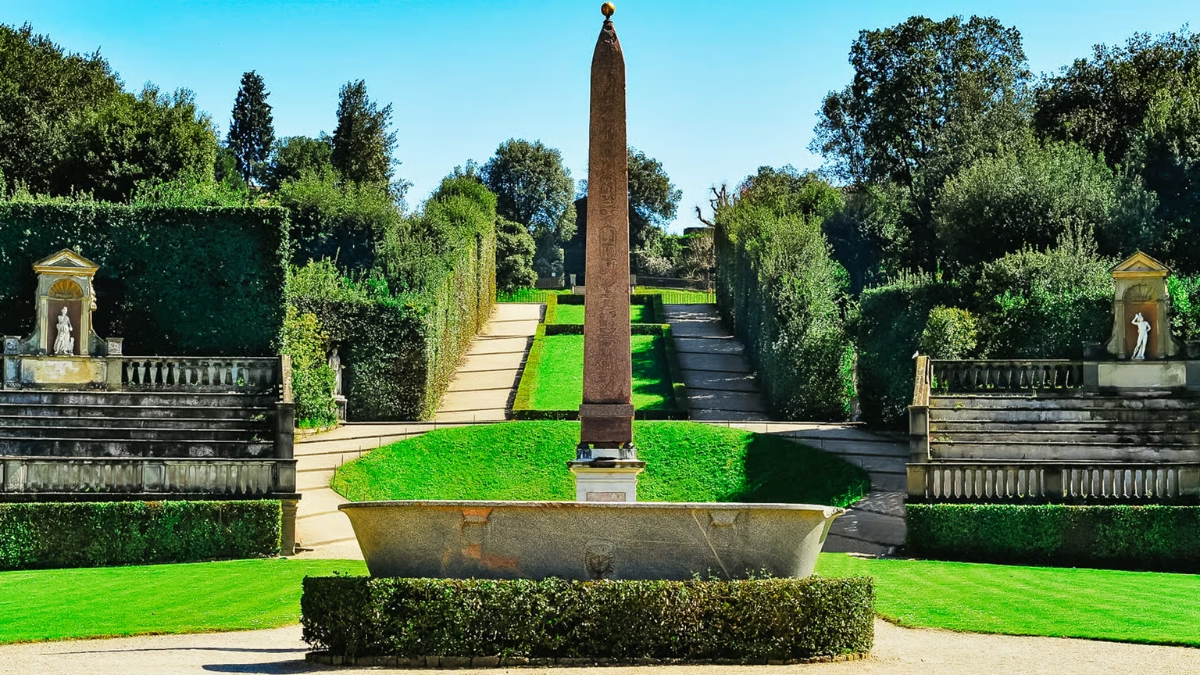
Boboli Gardens was begun in 1549 for Eleonora di Toledo and her husband Cosimo I de’ Medici, laid out behind the newly acquired Pitti Palace by Tribolo and continued by Ammannati, Vasari and Buontalenti. Expanded in the 17th century to around 45 hectares, it became the archetypal Italian Renaissance garden and now lies within the UNESCO Historic Centre of Florence.
Boboli Gardens is not just a green space behind a palace — it is a 470-year-old outdoor museum that helped define what a formal garden could be. Begun by the Medici in the mid-16th century and shaped by some of the greatest architects of the age, it turned a bare Florentine hillside into a stage of terraces, grottoes, fountains and cypress avenues that rulers across Europe would later imitate.
This guide traces that history: how the garden started in 1549, who designed it, how it grew over the following century, why it counts as the model “giardino all’italiana,” and the mark it left on European garden design.
Boboli Gardens History at a Glance
| Period | What happened |
|---|---|
| 1549 | Eleonora di Toledo and Cosimo I acquire Pitti Palace; garden begun |
| 1550s–1560s | Tribolo lays out the plan; Ammannati and Vasari continue the work |
| 1583–1593 | Buontalenti builds his Mannerist grotto |
| 17th century | Garden extended toward Porta Romana to around 45 hectares |
| 1982 | Included in the UNESCO Historic Centre of Florence |
Who Started Boboli Gardens and When
Boboli Gardens was started in 1549, the year Eleonora di Toledo — wife of Duke Cosimo I de’ Medici — bought Pitti Palace. The couple wanted a grand garden rising up the hill behind their new residence, and the sculptor-architect Niccolò Tribolo drew up the first plan. Work continued for decades under later Medici dukes, making the garden a multi-generation family project.
The story begins with a purchase. In 1549 Eleonora di Toledo, the Spanish-born wife of Cosimo I de’ Medici, acquired the unfinished Pitti Palace in the Oltrarno, on the south bank of the Arno. The family wanted more than a residence; they wanted a garden worthy of a ruling dynasty, climbing the slope behind the palace toward the Forte Belvedere hill.
The first designer was Niccolò Tribolo, a sculptor and garden-maker who had already worked on Medici villa gardens. He set out the garden’s central logic — an axis rising from the palace, terraces cut into the hillside, and space for water features and sculpture. Tribolo died in 1550, early in the project, but the framework he established guided everything that followed.
The Architects Who Shaped It
After Tribolo’s death, Boboli passed through a remarkable roster of designers: Bartolomeo Ammannati, Giorgio Vasari and Bernardo Buontalenti. Ammannati worked on the palace courtyard and the amphitheater area, Vasari contributed to the layout, and Buontalenti added his famous Mannerist grotto between 1583 and 1593. Their combined work spans roughly the second half of the 16th century.
Boboli is really the sum of several great hands. Bartolomeo Ammannati, best known for the courtyard he built onto Pitti Palace, helped shape the lower garden and the hollow that became the hillside amphitheatre directly behind the palace. Giorgio Vasari — architect of the Uffizi and the Vasari Corridor — was also involved in the garden’s development during the same period.
The most theatrical contribution came from Bernardo Buontalenti, the Medici court’s master of spectacle. Between 1583 and 1593 he built the Buontalenti Grotto, a Mannerist cave of dripping-stone decoration, frescoes and sculpture near the garden’s entrance. It captured the era’s taste for surprise, artifice and the blurring of nature and art, and remains one of the most studied features in the whole garden.
The 17th-Century Expansion
The Boboli that visitors walk today is much larger than the Medici first laid out. In the early 17th century, under Cosimo II and his successors, the garden was extended southeast down the long slope toward Porta Romana. This is where the great cypress avenue, the Viottolone, descends to the Isolotto — the island garden with Giambologna’s Oceanus Fountain at its center.
The expansion roughly tripled the garden’s reach and gave it the scale it has now, around 45 hectares. It also added the sweeping perspectives and long sightlines that define the mature design: broad avenues that draw the eye downhill, framed by dark cypress and punctuated by statues, fountains and clipped hedges. What began as a compact palace garden had become a landscape.
The Archetypal Italian Renaissance Garden
Boboli is regarded as the model “giardino all’italiana” — the Italian Renaissance garden — because it combines the elements that define the style: geometric layout, terraces exploiting a slope, axial avenues, sculpture as a structural element, elaborate waterworks and grottoes, and carefully framed views. Later formal gardens across Europe drew directly on this template.
What makes Boboli the textbook Italian garden is how completely it brings together the style’s ingredients. The design is geometric and axial, using the natural hillside as a series of terraces rather than fighting it. Sculpture is not decoration added later but part of the architecture — the statues and antiquities punctuate avenues, close off vistas and populate the fountains.
Water and surprise are central too. The fountains of Boboli — the Neptune Fountain on the hill, the Oceanus Fountain on the Isolotto — and the grottoes gave the Medici moving water, cool shade and theatrical effect in an age when engineering such displays was a show of power. The garden reads as an open-air museum where architecture, sculpture and horticulture are inseparable, which is exactly what the “giardino all’italiana” was meant to be.
UNESCO Status and European Influence
Boboli’s importance is recognized formally: it sits within the UNESCO World Heritage Historic Centre of Florence, inscribed in 1982. But its influence spread far beyond Italy long before that. As the Medici garden par excellence, Boboli became a reference point for rulers who wanted gardens that projected the same sophistication and control over nature.
Its DNA — terraces, axial avenues, sculptural waterworks, framed perspectives and grottoes — reappears in formal gardens across Europe in the following centuries, feeding into the grand French and wider Continental garden traditions. When you walk the Viottolone down toward the Isolotto, you are seeing the prototype that generations of garden designers studied and adapted. To turn that history into a route on the ground, pair this with our guide to what to see and the best time to visit.
Frequently Asked Questions
When were Boboli Gardens built?
Boboli Gardens was begun in 1549, the year Eleonora di Toledo and Cosimo I de’ Medici acquired Pitti Palace. The initial layout dates from the 1550s under Tribolo, with major work continuing through the second half of the 16th century and a large expansion in the 17th century. In other words, the garden you see today took well over a century to reach its full extent.
Who designed Boboli Gardens?
Several leading Renaissance architects shaped it. Niccolò Tribolo drew the first plan in 1549–1550, and after his death the work passed to Bartolomeo Ammannati, Giorgio Vasari and Bernardo Buontalenti. Buontalenti built the famous grotto between 1583 and 1593. Because so many hands contributed over decades, Boboli reflects the evolving tastes of the whole later Renaissance rather than a single designer’s vision.
Why is it called Boboli?
The name is generally linked to the Borgolo or Boboli family, who are thought to have owned land on the hillside before the Medici developed it. The garden takes its name from that earlier association with the site. Today “Giardino di Boboli,” or Boboli Gardens in English, refers to the whole 45-hectare garden behind Pitti Palace.
Who were the Medici and why did they build it?
The Medici were Florence’s ruling family, and Cosimo I was the first Grand Duke of Tuscany. For a dynasty, a garden on this scale was a statement of wealth, taste and command over nature and engineering. Boboli gave the family a private landscape for ceremony, spectacle and leisure directly behind their residence at Pitti Palace, and a stage on which to display their art collection outdoors.
What makes Boboli a Renaissance garden?
It brings together the defining features of the Italian Renaissance garden: a geometric, axial plan; terraces that use the natural slope; sculpture built into the design; elaborate fountains and grottoes; and long framed views down avenues like the cypress-lined Viottolone. This combination is why Boboli is considered the archetypal “giardino all’italiana” and a model that later European gardens followed.
Is Boboli Gardens a UNESCO World Heritage Site?
Yes, indirectly. Boboli lies within the Historic Centre of Florence, inscribed on the UNESCO World Heritage List in 1982. The garden is counted among the historic assets that give central Florence its outstanding cultural value, alongside the cathedral, the Uffizi and the city’s Renaissance monuments. Its state is managed as part of Florence’s protected historic core.
How big are Boboli Gardens?
The garden covers around 45 hectares today, having grown from a much smaller core after the 17th-century expansion toward Porta Romana. That scale is part of why a full visit takes two to three hours — see our guide on how long to spend. The terrain is hilly, with gravel paths and limited shade, so comfortable shoes matter.
Can you still see the original Medici features?
Yes. Many of the garden’s defining Medici-era elements survive, including Buontalenti’s grotto (1583–1593), the amphitheater with its Egyptian obelisk, the Neptune Fountain and the layout of the terraces above Pitti Palace. Later additions, such as the 17th-century Viottolone and Isolotto, are part of the historic fabric too. Walking the garden is effectively walking through several centuries of Medici and later Lorraine patronage.
